Mass differences in standard bank packaging for United States cents originate from the change in blank composition during 1982.
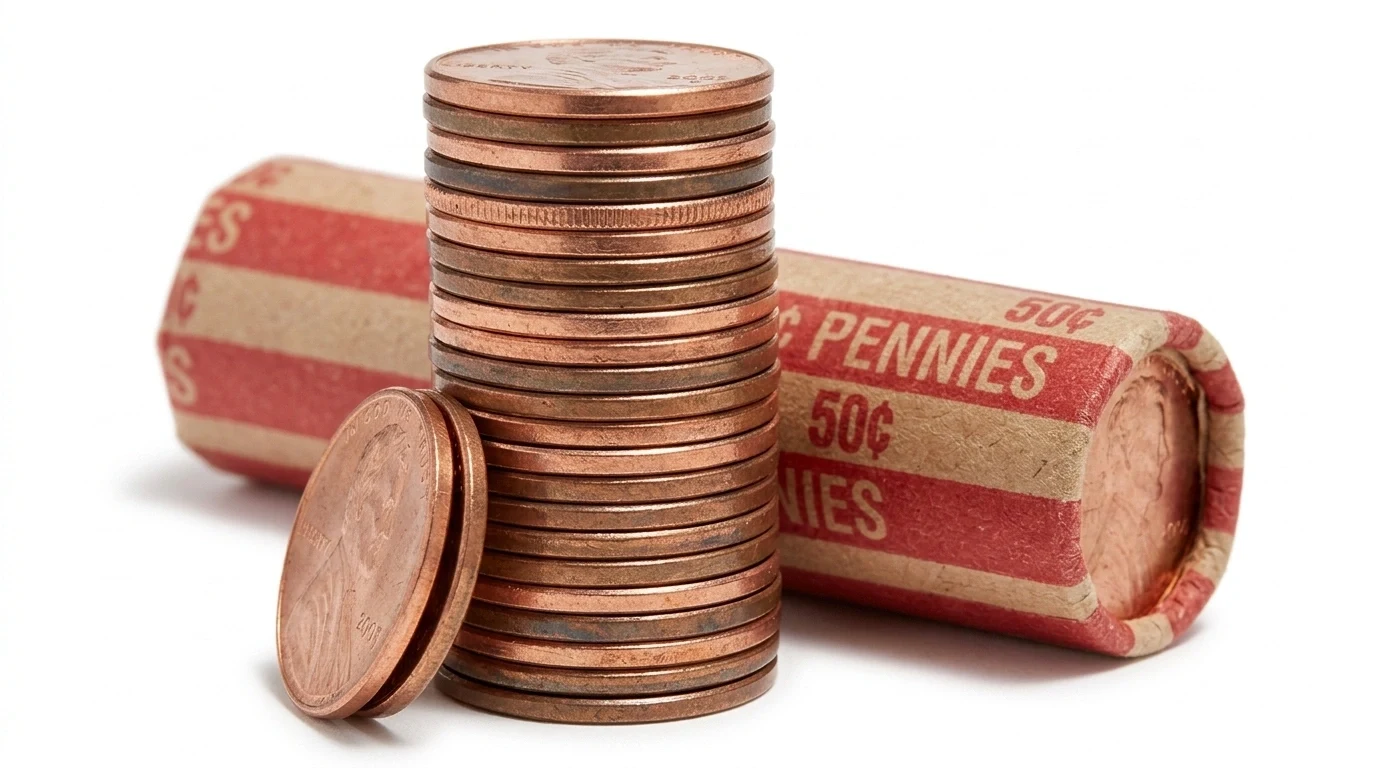
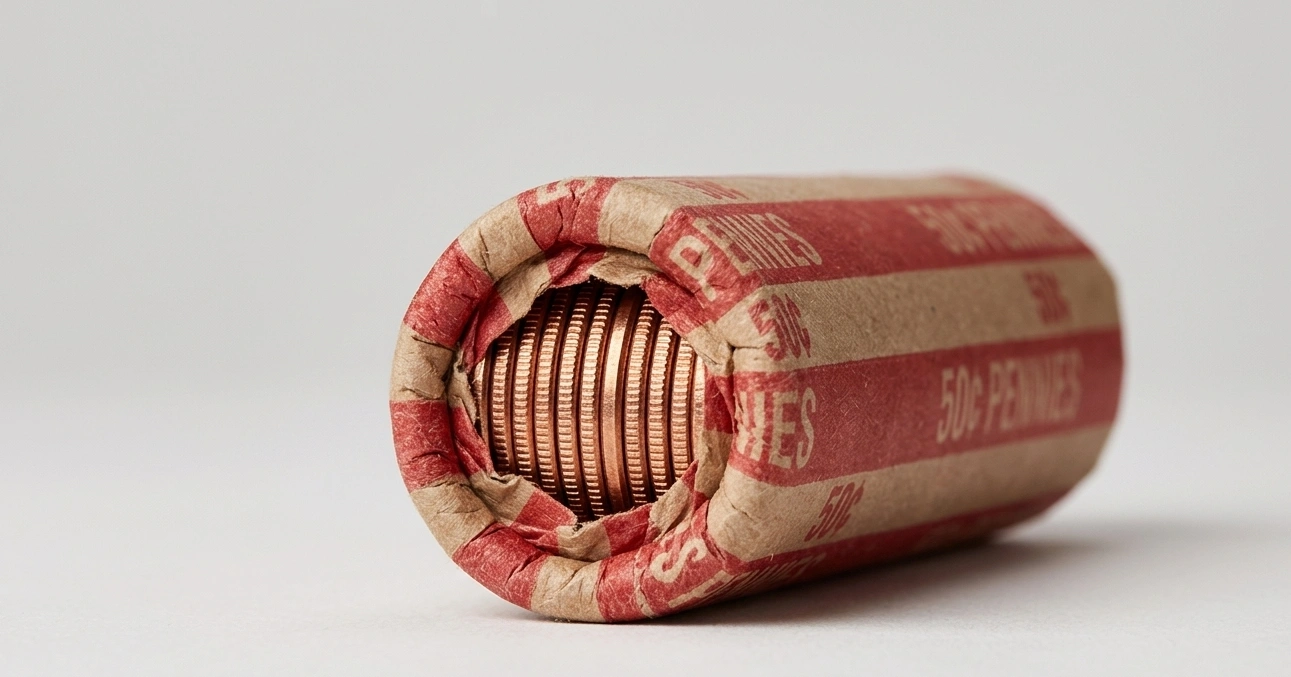
A bankroll contains exactly 50 coins of the same denomination.
Alterations in industrial standards led to the emergence of two clearly defined weight categories.
Investors use electronic scales for identifying the weight of a roll of pennies without opening the paper wrapper.
| Coin Type | Minting Period | Primary Metal | Unit Mass |
| Copper Cent | 1909 — 1982 | Copper | 3.11 grams |
| Zinc Cent | 1982 — 2026 | Zinc | 2.50 grams |
Allowable deviation for a copper specimen amounts to 0.13 grams.
The zinc version has a technological tolerance of 0.10 grams.
Calculated Mass of a Bank Roll
The weight of an empty paper wrapper varies from 0.8 to 1.1 grams.
Final indicators for closed packages appear as follows:
- Roll of copper coins → 156.5 — 157.3 grams
- Roll of zinc coins → 125.8 — 126.5 grams
- Mixed roll → 127.0 — 155.0 grams
The gap between a fully copper and a fully zinc roll reaches approximately 31 grams.
This figure equals the mass of ten copper coins.
Historical Transition of 1982
During the twelve months of 1982, production continued using both types of blanks.
Mints in Philadelphia and Denver released seven primary varieties.
A rare combination exists featuring the 1982-D small date on a copper blank.
Discovery of such an instance was recorded in 2016.
The price of this specific lot at Heritage Auctions reached $18,800.
The probability of finding a similar coin in an ordinary roll remains extremely low.
Metal Value Dynamics in 2026
The market price of copper exerts a direct influence on the investment attractiveness of old rolls.
The current copper quotation stands at $9.20 per kilogram.
The value of metal in one copper cent amounts to $0.028.
This exceeds the face value of the coin by 180%.
Zinc trades at the level of $2.85 per kilogram.
The metallic value of a modern cent represents only $0.007.
Growth in copper prices over the last three years reached 22%.
Technical Risks of Weighing
The presence of dirt or oxidation on coins increases the total mass.
Prolonged stay in circulation leads to weight loss due to mechanical abrasion.
A worn copper coin loses up to 0.05 grams of its mass.
Scales with accuracy to 0.01 grams constitute a necessary tool for analysis.
Using kitchen scales provides an error of up to 2 grams.
Such an inaccuracy makes the precise determination of mixed batch composition impossible.
Rare Specimens and Auction Records
The value of a roll increases in the presence of coins with high preservation levels.
Professional certification or usage of the Coin ID Scanner confirms surface quality and the absence of defects.
Price statistics for copper cents in MS 67 condition:
- 1909-S VDB — $115,000
- 1914-D — $25,000
- 1943-S (copper error) — $500,000
- 1955 (doubled die) — $15,000
The cost of ideal specimens increases by an average of 5% annually.
Zinc coins after 1982 are valued significantly lower.
Exceptions include specimens featuring production defects.
Causes and Consequences of Weight Anomalies
Factors changing the standard weight of a roll:
- Presence of 1943 steel cents → Mass decreases to 2.70 grams per piece
- Entry of foreign coins with similar diameter → Weight deviates unpredictably
- Moisture absorbed by the paper packaging → Mass gain up to 0.5 grams
- Use of plastic tubes instead of paper → Weight increase by 5-7 grams
Steel cents of 1943 possess magnetic properties.
Magnetic testing and usage of the coin app allow for the rapid exclusion of these items from the total mass.
| Asset Type | Roll Purchase Price | Real Copper Value | Rarity Premium |
| Modern Zinc | $0.50 | $0.35 | 0% |
| Mixed Roll | $0.50 | $0.85 | 5-10% |
| Copper (pre-1982) | $1.50 | $1.40 | 20-50% |
| Wheat Cents | $5.00 | $1.40 | 300-500% |
Investment in copper rolls is considered a method of capital preservation.
United States law prohibits the mass melting of coins for commercial purposes.
Ownership of such assets carries a long-term character.
Geometry and Packaging
The diameter of a cent measures 19.05 millimeters.
The thickness of a copper coin equals 1.55 millimeters.
Zinc coins have identical dimensions, ensuring the operation of vending machines.
Tight wrapping in paper excludes the movement of coins inside.
Looseness in a roll indicates a lack of weight or the presence of thin coins.
Methodology for Searching Valuable Specimens
The process of searching through rolls of coins is called Coin Roll Hunting.
Sequence of actions:
- Purchasing boxes at a bank. One box contains 50 rolls
- Weighing each roll without opening
- Selecting heavy rolls for detailed inspection
- Sorting by year and mint marks
- Searching for die varieties
The efficiency of the search directly depends on the volume of material viewed.
The percentage of finding old copper coins in circulation decreases by 2% annually.
In 2026, the share of copper in ordinary bank deliveries represents less than 8%.
Influence of Corrosion on Zinc Blanks
Zinc is subject to rapid chemical degradation upon contact with oxygen.
Microscopic damage to the copper plating leads to the formation of zinc bubbles.
This process irreversibly destroys the coin relief.
Copper coins from the 1950s are preserved better than modern specimens.
This creates a paradox where old coins look higher quality than new ones.
The cost of rolls in the original bank wrapping is higher by 15%.
The integrity of the paper serves as a guarantee of the lack of tampering.
Perspectives on Cent Abolition
The government discusses stopping the minting of cents due to production unprofitability.
Manufacturing one zinc cent costs $0.03.
Annual budget losses exceed $100,000,000.
Cessation of emission will lead to a sharp rise in the collective value of existing stocks.
The market will react with an increase in demand for rolls in Brilliant Uncirculated condition.
Weighing will remain the primary non-destructive control method.
| Check Purpose | Threshold Value | Result |
| Copper Search | > 156.0 g | Success |
| Silver Search (pre-1964 on quarters) | > 6.20 g | Not applicable for cent |
| Defect Detection | < 125.0 g | Check for thin planchet |
Automatic sorting systems use this weight sensor data.
Measurement accuracy determines the speed of cash processing.